   |
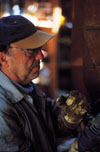
Anyone who has the opportunity to meet Fernand Vanderplancke in person, will quickly recognise the 'no-nonsense West Flanders type' in him.
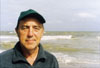
He has never renounced his roots in Bruges or his preference for the Westhoek, where he now lives, and for the flat, vast, peaceful land of De Moeren, where he invariably goes cycling every Sunday morning.
He speaks with zeal about the dunes – within walking distance of his home and studio – and the sea. The wondrous play of light, wind and water on every walk along the tide line fascinates him, and he never tires of watching the chaotic flight of the gulls. This is his world, his domain. Where birds, plants, and sometimes people make an impression on him, and constitute the germ of his sculptures.
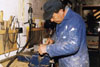
Fernand Vanderplancke works still many hours a day.
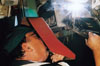
He is not the kind of sculptor who has a single speciality: far from it. He carves wood, welds metal, models and moulds in plaster. Plaster is the basis for his bronze sculptures, and in quiet moments he is to be found in his workshop, busy designing medals, commemorative medallions and plates using the finest engraving equipment. And, what may come as a surprise to many, the man who drew scraggy-looking heads in his very early days now commits more abstract impressions to paper.
This is his life's vision: "My work is the way I communicate. There's nothing I need add to it in words."

|
  |
FROM THE BIOGRAPHY
OF FERNAND VANDERPLANCKE
As his great model, he names Henry Moore, the versatile English sculptor who worked in various disciplines and who gave a new impetus to art in the English-speaking world, particularly after the Second World War.
Fernand Vanderplancke was in the seventies repeatedly given the opportunity by the Ministry of Culture to go and work abroad on study bursaries, in countries such as Hungary, Poland, Japan, Israel, Portugal and Italy.
It was in Poland that he met his mentor, Joseph Petruk, a professor at the Poznan Academy.
" From him I learnt to work with the highest quality as my only standard," says a still grateful and appreciative Fernand Vanderplancke.
In the eighties, there were quite a few exhibitions. He received commissions for major works and at the same time for medallions.
He was asked to sit on the Commission for the Plastic Arts in the province of West Flanders and was appointed Chairman of the Belgian National Council of Plastic Arts at UNESCO.
In 1987, after a successful exhibition in Knokke-Heist, Fernand decided that now was the moment to embark upon a full-time professional career as an artist.
The nineties were particularly exciting. There were a considerable number of large-scale public works. The most photographed and filmed sculpture anywhere on the coast of Flanders is 'The Seagulls' on the sea dyke at De Panne. The busts of Paul Delvaux and of the former mayor of Bruges, Frank Van Acker, also received extensive press coverage.
There were dozens – the number may in fact be in the hundreds by now – of smaller-format bronzes, and we should also not forget the numerous trophies created for sporting events and for deserving figures. Some 70 of Vanderplancke's commemorative medallions and plaques were included in the national medal collection in Brussels.
|